What is CMMS software and what is it for?
A CMMS (Computerized Maintenance Management System) is the system that allows an organization to plan, execute, control, and analyze the maintenance of its assets and facilities from a centralized platform.
The essential capabilities of maintenance software.
A complete CMMS covers the entire maintenance lifecycle, from the incident to cost analysis.
Corrective maintenance
Incident registration and management from notification to closure. Assignment, prioritization, and tracking of work orders.
Preventive maintenance
Scheduled maintenance plans and schedules with frequencies, automatic alarms, and regulatory compliance (RITE, RIPCI, REBT, RAT).
Indicators and KPIs
Average resolution time, incidents per period, SLA compliance, and cost per asset or provider.
Vendor management
Communication channel with contractors, tracking of assigned orders, and control of service level agreements (SLA).
Warehouses and stocks
Control of materials, spare parts, and consumption linked to work orders and assets.
Alerts and notifications
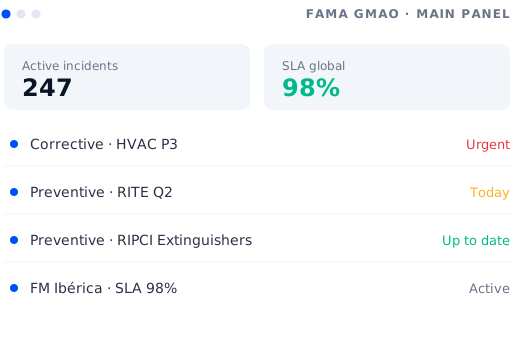
Automatic warnings for regulatory expirations, pending tasks, and SLAs at risk. Mobile app for technicians and providers.
How FAMA implements CMMS for buildings.
A CMMS built specifically for real estate and facilities.
Most CMMS solutions on the market originate from the industrial world. FAMA has been built since 1997 specifically for the management of buildings and facilities: hospitals, universities, public administrations, office networks, and large real estate portfolios.
This translates into a building-oriented data model, with a hierarchy of property → floor → space → asset.
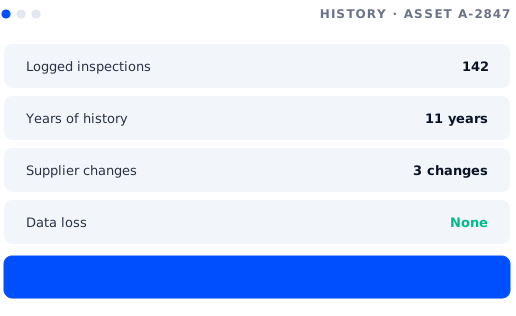
The history is yours, even if you change providers.
One of the most frequent problems in Facility Management is losing history when the contract holder changes. In FAMA, the organization always owns the data: providers access it during service delivery, but the history remains indefinitely.
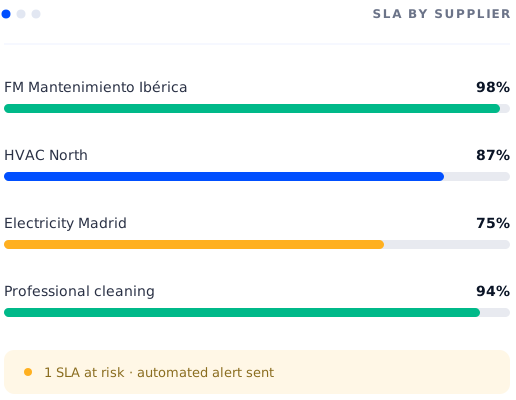
Service level agreements under control.
FAMA incorporates indicators associated with service level agreements (SLA), facilitating the tracking of compliance per provider through the app and web portal.
With and without CMMS software.
The difference between managing maintenance with data or without it.
| Aspect | Without CMMS | With FAMA CMMS |
|---|---|---|
| Incident registration | Email, telephone, paper | ✓ App and structured web portal |
| Preventive maintenance | Manual, outdated calendars | ✓ Automatic plans with alarms |
| Vendor control | No visibility of compliance | ✓ Real-time KPIs and SLAs |
| Cost per asset | Unknown or estimated | ✓ Actual accumulated cost |
| Regulatory compliance | Reactive, risk of sanctions | ✓ Alerts before expirations |
| Change of provider | Loss of history | ✓ Full history, always |
| Decisions based on | Perception and experience | ✓ Own and traceable data |
FAMA’s CMMS is part of FAMA AFM
It is not an isolated module. It is an integrated capability with assets, spaces, contractors, and sustainability in a single platform.
CMMS, CAFM, and IWMS: what is the difference?
FAQS
What is CMMS software and what is it for?
CMMS software is a system designed to organize and supervise an organization’s maintenance activities. It allows for asset registration, inspection planning, incident management, work order launching, history tracking, and consultation of key operational indicators.
When a company works with multiple facilities, technical staff, contractors, and compliance needs, a CMMS maintenance program becomes a necessary tool to structure activity and reduce dependence on manual or scattered processes.
In practice, CMMS software ensures that maintenance is no longer managed reactively and instead operates with greater foresight, better document control, and improved tracking capabilities.
What types of maintenance can be performed with Maintenance Management Software?
It is especially needed by organizations with a high volume and/or complexity of buildings, facilities, infrastructures, multiple assets, or internal and external maintenance teams that must be managed and optimized. It is also key when there are providers, compliance requirements, geographical dispersion, or a need to make decisions based on reliable operational data.
How does maintenance software work?
It functions as a central platform where assets, incidents, maintenance plans, work orders, documentation, and indicators are recorded. From there, the system helps plan tasks, assign responsibilities, track execution, and analyze activity to improve operational control.
What role does IoT play in CMMS software?
IoT can provide real-time field information on certain assets or facilities, which helps enrich maintenance tracking and detect behaviors that require attention. Its role is to complement management by providing data that the CMMS software can then integrate into operations and analysis.
What is CMMS software?
CMMS is the most widespread term for maintenance management software. In Spanish, the common equivalent is GMAO. Both concepts are used to refer to solutions that help organize assets, tasks, work orders, histories, and maintenance indicators.
What are the benefits of mobility in CMMS software?
Mobility improves operational agility because it allows for consulting information, reporting incidents, closing tasks, or reviewing work orders from the field. This reduces downtime, improves data updates, and makes it easier for technicians, supervisors, and providers to work with the most current information.
What advantages for decision-making does CMMS software offer?
It offers a more solid basis for decision-making because it converts daily activity into structured data. This allows for the analysis of workloads, incidents, task completion, response times, or asset behavior. With that visibility, the organization can better prioritize, adjust resources, and strengthen control.
Shall we take the step together?
Tell us what you need to manage and we will explain how we can help. No commitment—just a conversation between Facility Management professionals.