Physical asset and infrastructure management software.
Managing physical assets and infrastructure requires a single information base to understand the property portfolio, spaces, assets, and facilities, and to keep it updated over time.
Optimize resources, reduce inefficiencies, and guide investments with sound judgment.
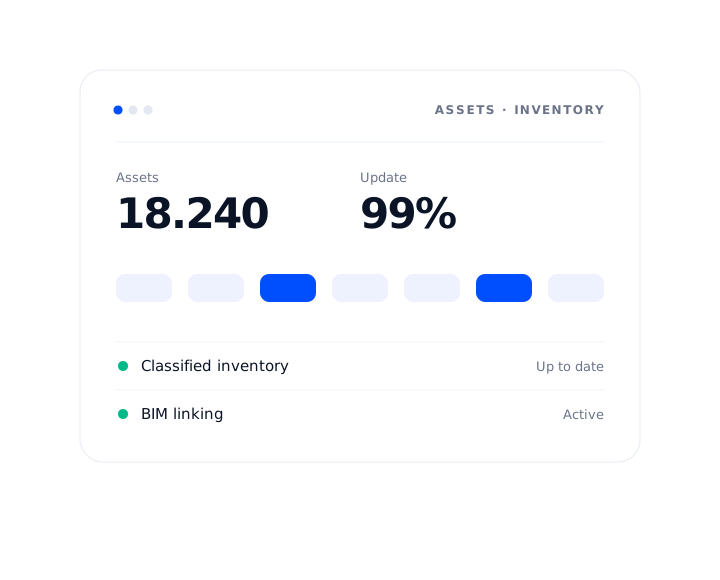
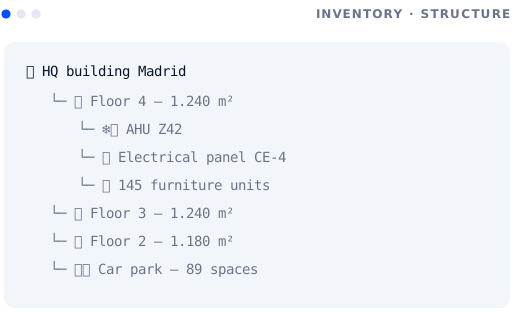
Structured inventory of assets and infrastructure.
Asset management begins with a reliable inventory. FAMA allows you to structure the inventory of physical assets, whether they are buildings, facilities, spaces, furniture, or equipment, maintaining a clear relationship between container and content.
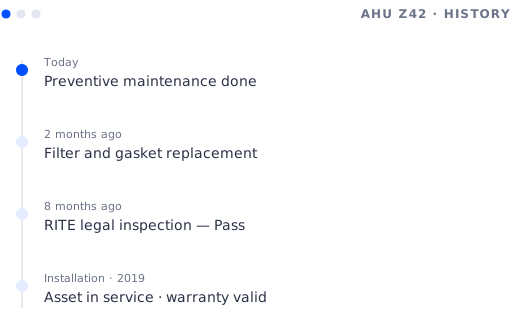
Information and traceability over time.
Beyond knowing what assets exist, it is crucial to have reliable data and a complete history. FAMA centralizes information associated with physical assets and provides traceability, allowing you to consult their evolution, changes, and context within the organization. This approach offers a continuous view of the asset, supporting decision-making and medium- to long-term planning.
Physical asset management with a global view.
FAMA allows for an integrated approach to asset management, considering both buildings and infrastructure, as well as the physical assets they comprise. The platform acts as a central point for organizing and consulting asset-related information, providing coherence and traceability throughout their lifecycle.
Classified Inventory
Hierarchical structure of properties, facilities, spaces, and equipment. Container and content connected.
Complete History
Temporal traceability: status, interventions, costs, and decisions throughout the lifecycle.
Single Database
Information shared with maintenance, sustainability, real estate assets, and CAE without duplication.
BIM and GIS Connection
Integration with DWG plans, BIM models, and GIS systems via API.
Usage Indicators
Analysis of distribution, occupancy, and evolution of the asset portfolio.
Multi-organization View
Adapted to structures with multiple locations, subsidiaries, or management units.
This feature is included in FAMA AFM
Learn about the FAMA product that supports this capability as part of a comprehensive platform.
Related features.
A technology partner, not just another vendor.
FAMA supports public and private organizations that require control, traceability, and reliability in managing their buildings and services.
Facility Management pioneers in Spain
Creators of Spain’s first Facility Management software in 1997 and a benchmark in the sector, backed by extensive experience as a technology partner to leading companies and public bodies.
An expert team that understands your organization
A strong, multidisciplinary team of professionals providing expertise and guidance throughout the cultural and operational change involved in an FM technology project.
Certified security and compliance
RGPD, ISO 27001, 9001, 14001, 22301 and ENS. Data center in Spain operated entirely by the FAMA team.
Financial strength and stability
We provide proven financial strength, giving our clients peace of mind with a stable partner that minimizes long-term operational risk.
Designed for demanding environments
FAMA is designed for public and private organizations that manage large volumes of assets and infrastructure.
Don’t see your industry?
We have extensive experience working with organizations across different industries and types. Tell us about your case and we will advise you with no obligation.
Ask Us →FAQS
What is physical asset management?
Physical asset management consists of organizing, structuring, and maintaining information related to an organization’s assets, including both buildings and infrastructure, as well as the physical assets contained within them, with the aim of having a clear and coherent overall view.
What types of assets can be managed?
Physical assets and infrastructure can be managed, including buildings, facilities, spaces, furniture, equipment, or other inventory items, maintaining the relationship between the ‘container’ asset and the ‘content’ asset.
Difference between assets and real estate assets?
Physical assets are the managed physical elements; real estate assets focus on property ownership and its legal dimension. Both are managed in connection within FAMA.
Does it integrate with BIM and CAD plans?
Yes, it links assets to their graphical representation through bidirectional integration with DWG plans and BIM models via the Forge API.
How does asset management differ from maintenance?
Asset management focuses on the knowledge, control, and traceability of asset information over time. Maintenance is a complementary discipline, aimed at preserving the asset, but it does not, by itself, address the overall organization and governance of asset information.
What does asset management software provide?
In general, asset management software centralizes physical asset information, facilitates its consultation and maintenance, and provides traceability and history to offer a global view that supports decision-making and coordination between areas.
In FAMA, this management also functions as a common working environment for the profiles involved in the day-to-day operations of the building: management responsibles, internal users, and operational teams (in-house or external providers) who perform maintenance and general services, ensuring that everyone works from the same information base.
Is asset management the same as "asset tracking"?
Not exactly. In this context, asset management is not limited to one-time tracking, but provides traceability and historical asset information, allowing for a continuous understanding of its evolution within the organization.
How does asset management relate to buildings and facilities?
Asset management integrates with building and facility information, allowing each asset to be contextualized within its environment and facilitating a structured understanding of the whole.
What type of organizations is asset management aimed at?
It is especially relevant for organizations that manage buildings and infrastructure and require structured control of physical assets, for example:
- Large asset owners, public or private.
- Organizations with a high number of employees (e.g., +500) and space management needs.
- Environments with high asset dispersion or a large volume of inventory items.
- Organizations highly dependent on contractors and outsourced services that require traceability and control.
Shall we take the step together?
Tell us what you need to manage and we will explain how we can help. No commitment—just a conversation between Facility Management professionals.