Technology for sustainability and quality management in organizations.
Automate and centralize your organization's sustainability management. Footprint calculation, waste management, ESG indicators, and support for ISO systems in a single environment connected to the rest of your Facility Management operation.
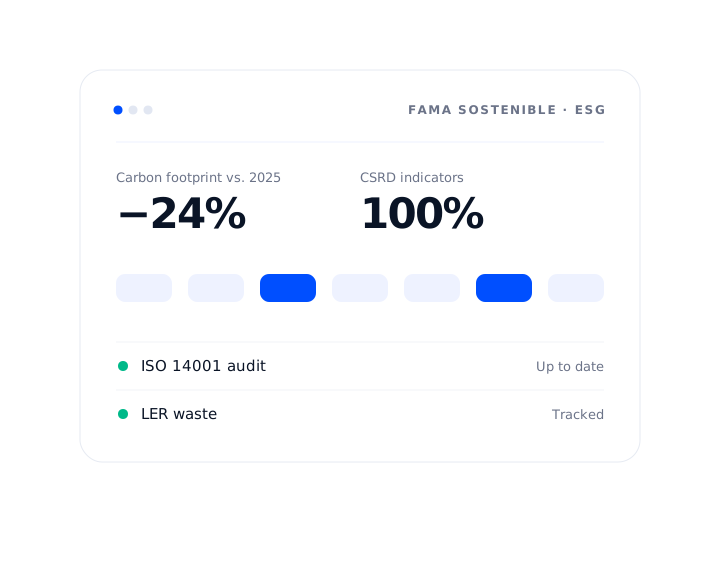
Sustainability managed as a strategic asset.
FAMA SOStenible software converts sustainability into traceable, measurable, and auditable information. Connected to the rest of the operation, not as a separate silo.
Environmental footprint calculation
Calculation and visual analysis of the environmental footprint, carbon footprint, and water footprint. Automation of the data collection process, calculation of indicators, and analysis of results. Facilitates environmental performance management and the definition of improvement plans.
Waste Management
Identification by EWC code, warehouse management, transfers between centers, and full documentary traceability. Calculation of indicators based on waste characteristics.
CSRD and reporting according to ESRS
Automatic integration of ESG indicators in accordance with the Corporate Sustainability Reporting Directive (CSRD). Downloadable reports aligned with SDGs and the 2030 Agenda.
ISO and EMAS systems
FAMA SOStenible facilitates the establishment, documentation, implementation, maintenance, and continuous improvement of various management systems: ISO 14001, 9001, 45001, 50001, and EMAS. Documentary traceability, approval flows, and non-conformities.
Circular economy
Optimization of waste management processes toward zero waste to landfill. Real-time tracking App to achieve efficiency and speed. Facilitates obtaining reports for control and decision-making. Speeds up the achievement of zero waste goals.
Energy monitoring
Integration with PLC and BMS to monitor consumption in real time, detect savings, and generate reports. Detection of factors affecting consumption. Rate recalculation simulations. Reports for economic expenditure control.
FAMA SOStenible can be integrated with
The integration capability of FAMA SOStenible allows connecting the solution's operations with other organizational systems, favoring more coordinated infrastructure management and a more consistent view of information.
A technology partner, not just another vendor.
FAMA supports public and private organizations that require control, traceability, and reliability in managing their buildings and services.
Facility Management pioneers in Spain
Creators of Spain’s first Facility Management software in 1997 and a benchmark in the sector, backed by extensive experience as a technology partner to leading companies and public bodies.
An expert team that understands your organization
A strong, multidisciplinary team of professionals providing expertise and guidance throughout the cultural and operational change involved in an FM technology project.
Certified security and compliance
RGPD, ISO 27001, 9001, 14001, 22301 and ENS. Data center in Spain operated entirely by the FAMA team.
Financial strength and stability
We provide proven financial strength, giving our clients peace of mind with a stable partner that minimizes long-term operational risk.
Designed for demanding environments
FAMA is designed for public and private organizations that manage large volumes of assets and infrastructure.
Don’t see your industry?
We have extensive experience working with organizations across different industries and types. Tell us about your case and we will advise you with no obligation.
Ask Us →Other FAMA products.
FAMA AFM
Integrated management of assets, buildings, maintenance, and spaces in a single environment.
Discover FAMA AFM →FAMA OHS/CAE
Coordination of business activities (CAE) and preventive compliance control.
Discover FAMA OHS/CAE →FAMA RESERVAS
Automates the reservation of rooms, workstations, and other workspace resources.
Learn about FAMA Resource Booking →FAQS
Which environmental footprints can be calculated with FAMA SOStenible?
FAMA SOStenible allows you to calculate, manage, and analyze the organization’s main environmental footprints through a single system:
- Environmental footprint: analysis of up to 16 impact categories, with conversion of midpoint and endpoint indicators to obtain a global environmental score.
- Carbon footprint: calculation of the greenhouse gas (GHG) emissions inventory in accordance with international standards such as ISO 14064, ISO 14067, or the GHG Protocol, at corporate, product, or service levels.
- Water footprint: calculation according to the ISO 14046 standard, differentiating between blue, green, and gray water to facilitate the management and optimization of water use.
What are the advantages of FAMA SOStenible for calculating environmental footprints?
FAMA SOStenible automates the data collection process, indicator calculation, and results analysis, facilitating environmental performance management and the definition of improvement plans.
Main system capabilities:
- Automation of environmental footprint calculation using configurable templates.
- Automatic unit conversion in multi-unit environments.
- Centralized management for multiple products and services.
- Obtaining key indicators and visual analysis of results.
- Identification of opportunities to reduce environmental impacts.
With the information collected, FAMA SOStenible facilitates the definition of strategies for the reduction, optimization, and compensation of environmental impacts, supporting organizations in the continuous improvement of their sustainability performance.
What does the Corporate Sustainability Reporting Directive (CSRD) establish?
The Corporate Sustainability Reporting Directive (CSRD) establishes that companies must disclose detailed information on their environmental, social, and governance (ESG) performance.
The European Sustainability Reporting Standards (ESRS) provide a common and mandatory framework for companies to report their performance in these areas.
Having a single environmental indicator, in accordance with the ESRS, facilitates the communication of the organization’s ESG performance to different stakeholders in a clear and simplified manner. This not only improves competitiveness and efficiency but also helps mitigate risks affecting the organization’s sustainability, optimizing opportunities and reducing the overall negative impact.
This new Directive also contributes to the fulfillment of the Sustainable Development Goals (SDGs).
What advantages does FAMA SOStenible offer organizations regarding the Corporate Sustainability Reporting Directive (CSRD)?
FAMA SOStenible allows for the integration of ESG indicators into an automated, downloadable, and editable report aligned with the SDGs 2030 Agenda:
- It differentiates between various sustainability indicators under ESRS standards, identifying the environmental, social, and good governance aspects of each organization.
- It allows for the parameterization and association of ESG indicators with different standards (ESRS, SDGs, etc.), representing the organization’s commitment to non-financial information.
- It is capable of consolidating non-financial information data in a single platform alongside other management systems (ISO 9001, 14001, etc.), waste management, or other calculations such as the carbon footprint.
What are the capabilities of FAMA SOStenible in relation to waste management?
In the waste management process, FAMA SOStenible has the capacity to assist organizations in the following phases:
Definition:
- Full characterization of hazardous and non-hazardous waste based on current legislation.
- Registration of collection points and the spaces containing them, as well as the definition of the waste stored.
- Establishment of minimum and maximum waste storage stocks.
- Assignment of authorized managers and transporters according to the EWC code and the Autonomous Community.
- Generation of alarms for maximum time and waste storage capacity warnings (6 months for hazardous waste).
Movements and warehouse control:
- Registration of entries, transfers between warehouses within the same workplace, transfers between workplaces, and shipments to authorized waste managers.
- Control of current warehouse stock.
- Incorporation of documentation associated with waste production operations: certificates, waste records, proof of delivery, waste acceptances, transfer notifications, etc. (through the Document Management module).
Results:
- Waste movement reports.
- Waste generation reports at different levels: country, autonomous community, workplace, warehouse, etc.
- Calculation of indicators based on the waste itself, hazardous or non-hazardous, waste destination, etc. (through the Indicators module).
How does FAMA SOStenible contribute to the circular economy?
FAMA SOStenible facilitates and automates processes related to the Circular Economy for any organization:
- It allows for the identification, definition, and parameterization of all aspects to be considered in our organization within the scope of the circular economy.
- It provides an APP to gain efficiency and speed in the processes involved and to carry out exhaustive real-time tracking of waste movement.
- It facilitates obtaining reports for daily control and decision-making.
- It speeds up the achievement of zero waste to landfill goals, meaning all waste generated by the organization’s production activity is recovered and recycled, thus achieving high economic benefits.
How does FAMA SOStenible operate in the management of ISO standards?
FAMA SOStenible facilitates the establishment, documentation, implementation, maintenance, and continuous improvement of the organization’s various management systems related to ISO standards:
ISO 14001 – ISO 9001 – ISO 45001 – ISO 50001 – EMAS
It contributes to:
- Defining the scope of the Environmental Management System.
- Day-to-day management of the work performed within the scope.
- Performing the necessary tasks to verify compliance with current legislation and the objectives defined by the organization.
How does FAMA SOStenible help in processes related to organizational energy efficiency?
FAMA SOStenible allows for consumption monitoring, providing
the possibility of integration with devices to:
- Obtain detailed knowledge of the organization’s energy consumption (PLC, BMS type).
- Detect factors affecting said consumption and identify different saving opportunities.
- Facilitate the management of costs associated with each property or workplace based on the previously configured rate.
- Perform simulations through rate recalculation.
- Generate reports for the economic control of energy expenditure.
- Visualize trends in energy consumed by period and the differential relative to the base period, as well as passive consumption.
Shall we take the step together?
Tell us what you need to manage and we will explain how we can help. No commitment—just a conversation between Facility Management professionals.